
Dark circles are among the most common cosmetic concerns we address at House of Aesthetics — and also one of the most persistently misunderstood. Patients arrive having tried every cream, serum, and home remedy available online, with little improvement to show for it.
The reason these solutions rarely work is a fundamental one: dark circles have multiple distinct causes, and each requires a completely different treatment approach. Treating pigmentation-based dark circles with a filler is futile. Treating hollow under-eyes with a pigmentation laser will do nothing. Without identifying the correct underlying cause, treatment is essentially guesswork.
This guide breaks down exactly what is causing your dark circles — and which clinical treatments actually deliver results for each type.
The Four Root Causes of Dark Circles
1. Pigmentation (Melanin-Based)
Pigmentation dark circles are caused by an excess of melanin in the periorbital skin — the thin, delicate skin around the eye. This type is extremely common in South Asian skin tones and presents as a brownish or brownish-grey discolouration beneath the eyes.
Contributing factors include:
- Sun exposure (the periorbital area is highly susceptible to UV-induced melanin production)
- Chronic eye rubbing, which causes repeated microtrauma and melanin release
- Genetics — periorbital pigmentation has a strong hereditary component
- Atopic dermatitis (eczema), which frequently causes periorbital skin darkening
This is the type most people are thinking of when they picture “dark circles.”
2. Vascular / Thin Skin (Bluish or Purplish)
This type of dark circle has a distinctly bluish or purple tone, caused by the underlying blood vessels showing through the extremely thin periorbital skin. As we age, the skin thins and loses collagen — making this vascular shadow more prominent.
Poor sleep, dehydration and fatigue make vascular dark circles more visible temporarily (by causing blood vessel dilation), but the underlying structural issue is not caused by lack of sleep — it is structural.
3. Volume Loss (Tear Trough and Under-Eye Hollowing)
As we lose subcutaneous fat and bone volume in the mid-face with age, a hollow develops beneath the eye at the junction of the lower eyelid and cheek. This creates a shadow that appears as a dark circle — not because of pigment or blood vessels, but because of a three-dimensional contour depression that the light hits at an angle.
This type is often accompanied by a visible groove or trough beneath the eye. It becomes more pronounced with age and is rarely present in younger patients without contributing factors.
4. Structural / Anatomical
Some patients have a naturally deep tear trough or a prominent orbital rim due to their facial bone structure. This creates a shadow independent of fat loss or skin thinning. It is essentially an anatomical characteristic.
Why Getting the Diagnosis Right Matters So Much
The periorbital area is one of the most delicate areas of the face. Treatments applied incorrectly here — particularly fillers — can have significant complications. The under-eye area has a dense vascular network, and filler injected without proper technique, depth control and anatomical knowledge carries risks that do not exist elsewhere.
This is why dark circle treatment must be performed by a qualified aesthetic dermatologist or cosmetic physician — not at a salon, a general beauty clinic, or by a non-physician injector. At House of Aesthetics, all injectable treatments are performed by our dermatologist personally.
Treatments for Each Type of Dark Circle
Pigmentation-Based Dark Circles
Topical prescription agents are the starting point. Vitamin C, kojic acid, azelaic acid and hydroquinone (used carefully and for limited periods) can gradually lighten periorbital pigmentation when used consistently over weeks.
Laser toning with QSwitch Nd:YAG is the most effective clinical treatment for pigmentation-based dark circles. By delivering precise energy to melanin pigment in the periorbital skin, it breaks down excess melanin without damaging surrounding tissue. A course of 6–8 monthly sessions is typically recommended, with gradual visible lightening over time. This is safe for Indian skin tones when the correct parameters are used.
Chemical peels — very mild superficial peels can be applied to the periorbital area by an experienced dermatologist, but this requires significant care due to the delicacy of the skin. Mandelic or lactic acid peels at low concentrations are preferred.
PDRN (Rejuran) — polynucleotide injections into the periorbital skin stimulate fibroblast activity, improve skin quality and thickness, and reduce the translucency that makes underlying pigment appear darker. PDRN is an excellent treatment for this type when combined with laser.
Vascular / Thin-Skin Dark Circles
The primary strategy here is to improve the quality and thickness of the periorbital skin — reducing its translucency so the underlying vessels are less visible.
PDRN / Rejuran Healer is particularly well-suited here. Polynucleotide injections stimulate collagen production and improve skin thickness and quality in the periorbital area, reducing the visibility of underlying vasculature. It is often called the “skin restorer” precisely because of its effect on thin, damaged skin.
Skin booster injections (very light hyaluronic acid) can also improve skin hydration and quality in the periorbital area, reducing translucency.
Topical retinoids (physician-prescribed, and used carefully around the eye) gradually build collagen over months and reduce skin translucency.
Volume Loss / Tear Trough Hollowing
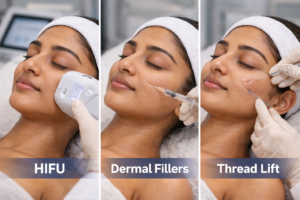
This is the domain of dermal fillers — specifically, hyaluronic acid filler injected precisely into the tear trough area to restore volume and eliminate the shadow-casting hollow. When done correctly by an experienced injector, tear trough filler delivers immediate, dramatic improvement that can last 9–18 months.
The technique matters enormously. Tear trough filler requires:
- Deep injection planes (onto or just above periosteum)
- A soft, low-cohesivity HA filler product appropriate for the area
- Conservative volume (overcorrection in this area creates puffiness, known as the “Tyndall effect”)
- A dermatologist or trained physician with specific experience in periorbital anatomy
At House of Aesthetics, tear trough filler is performed conservatively and with a long safety record. We discuss the procedure, the volume plan and realistic expectations fully before proceeding.
Profhilo — a bioremodelling agent with high HA concentration — can also be used in the periorbital area to stimulate collagen and elastin production, improving skin quality and providing mild volume restoration. It is often recommended alongside filler for a more comprehensive result.
Structural / Anatomical Dark Circles
Structural tear trough darkness requires the same approach as volume loss — filler to recontour the under-eye area and reduce the shadow cast by the anatomical groove. In some cases, patients with very prominent anatomical dark circles may be referred to an oculoplastic surgeon for assessment of surgical options (lower blepharoplasty), though this is rarely the first recommendation.
Do Under-Eye Creams Work?
Honestly — very few do, and none in the way their marketing claims. Most periorbital creams cannot penetrate deeply enough to address vascular, structural or significant pigmentation causes. Some caffeine-containing products temporarily constrict blood vessels and reduce puffiness. Vitamin K creams have limited evidence for vascular dark circles.
For pigmentation-based dark circles, a dermatologist-prescribed topical regimen with the right ingredients can make a real difference — but the concentrations in OTC products are typically too low to produce significant change.
Can Dark Circles Be Permanently Removed?
This is one of the most common questions in our consultation room, and the honest answer is: it depends on the cause.
- Filler for volume loss lasts 9–18 months and requires repeat treatment — not permanent, but highly effective and long-lasting
- Laser for pigmentation produces lasting improvement, but maintenance sessions and strict sun protection are needed to prevent recurrence
- PDRN results persist for 6–12 months before a top-up is beneficial
- Structural and genetic dark circles require management rather than cure
The goal is significant, lasting improvement that is maintained with a sensible treatment plan — not a single magic session.
Book Your Dark Circle Consultation in South Delhi
If dark circles have been a persistent concern, a proper diagnosis of the cause is the essential first step. At House of Aesthetics, our dermatologist will assess your specific type — pigmentation, vascular, volume loss or structural — and recommend a targeted treatment plan.
Book a consultation at our Greater Kailash clinic. We see patients from Defence Colony, Hauz Khas, Lajpat Nagar, South Extension, Saket and across South Delhi.
This article has been reviewed and approved by the dermatologist at House of Aesthetics, Greater Kailash, Delhi. It is intended for informational purposes and does not replace a clinical consultation.