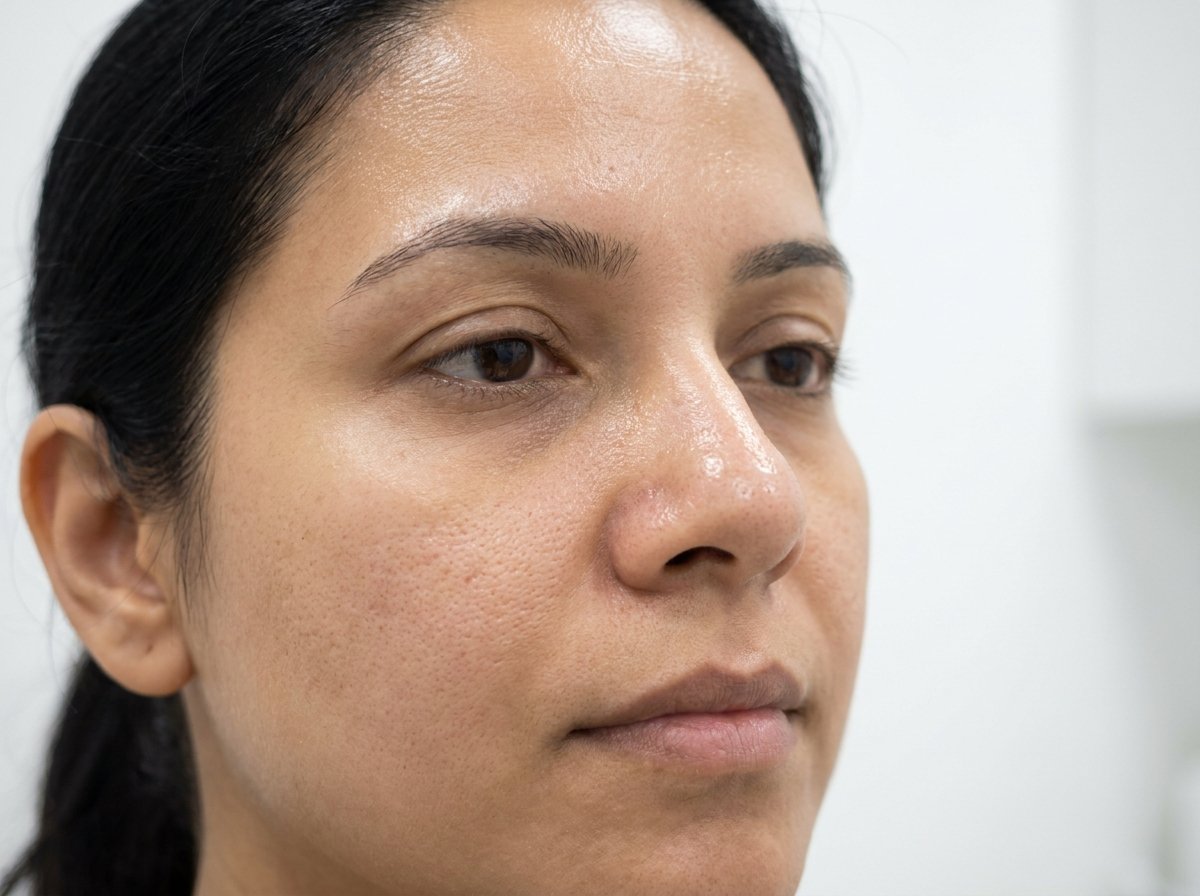
Open pores are one of the most frequently searched skin concerns in India — and one of the most misunderstood. Walk into any pharmacy and you will find dozens of products claiming to “close” or “minimise” pores. Social media feeds are full of filters and blurring techniques that make pores look invisible. Yet in a clinical consultation, the question we hear most often is: “Why hasn’t anything worked?”
The answer is that most over-the-counter solutions address the appearance of pores on the skin’s surface — not the underlying structural reasons why they are enlarged. Effective, lasting pore reduction requires treatment that works at the level of the dermis, where the real change happens.
Here is an honest clinical guide to what large pores are, why they appear, and the five treatments that deliver proven results.
What Are “Open Pores” and Why Do They Appear?
A pore is the opening of a hair follicle on the skin’s surface. Every pore has a sebaceous (oil) gland attached to it. When pores are referred to as “open” or “large,” what is actually happening is that the pore opening has become visibly enlarged — most commonly due to one or more of the following:
Excess sebum production. When the sebaceous gland produces more oil than necessary, it stretches the pore wall. This is particularly pronounced in oily skin types and in Delhi’s heat and humidity.
Loss of collagen and skin elasticity. Collagen fibres in the dermis act like a support structure around each pore. As collagen breaks down with age, sun damage and environmental stress, pores lose this structural support and appear wider.
Sun damage. UV radiation is one of the leading accelerators of pore enlargement. Chronic sun exposure damages collagen and increases sebum production simultaneously.
Acne and comedones. When pores are clogged with sebum, dead skin cells and bacteria, the physical blockage stretches the pore wall. Even after the blockage clears, the pore may remain enlarged if the surrounding structure has been weakened.
Genetics. Some skin types are inherently more prone to visible pores. Individuals with naturally oilier skin or specific genetic backgrounds see larger pores earlier and more prominently.
The Truth About Pore Size
Pores cannot technically be “opened” or “closed” — the concept of opening pores with steam and closing them with cold water is a beauty myth that has been definitively disproved by research. Pores do not have muscles that contract or dilate.
What can change is:
- The amount of debris and sebum inside the pore (which makes it appear larger)
- The structural integrity of the collagen and elastin surrounding the pore (which determines how wide it appears at rest)
- The skin’s overall texture and smoothness
This distinction matters enormously for treatment. Cleaning and exfoliating helps with the first point. Real structural improvement — the kind that lasts — comes from treatments that address the second.
5 Clinically Proven Treatments for Open Pores
1. MNRF — Microneedling Radiofrequency
MNRF is our most recommended treatment for enlarged pores, and for good reason. It is the only widely available procedure that directly stimulates deep dermal collagen remodelling — rebuilding the structural support around each pore from below the surface.
Fine insulated needles penetrate the skin to a precise depth (controlled by your dermatologist based on your skin type and concern). At the tip of each needle, radiofrequency energy is delivered directly into the dermis, creating a controlled thermal injury that triggers intensive collagen and elastin production.
The results for pore reduction are significant:
- Pores visibly tighten as surrounding collagen builds and firms
- Skin texture smooths overall
- Oil production reduces modestly as the sebaceous glands are mildly affected
- Results accumulate with each session and continue improving for 3–6 months after the final session
A typical course is 3–4 sessions, spaced 4–6 weeks apart. MNRF is safe for Indian skin tones — unlike ablative lasers, it has minimal risk of post-inflammatory hyperpigmentation.
2. Chemical Peels
Chemical peels address pores by exfoliating the dead skin cells and sebum that block and visually enlarge them, while also stimulating mild collagen renewal at the epidermal-dermal junction.
Salicylic acid peels are particularly effective for pore reduction because salicylic acid is oil-soluble. It penetrates into the pore itself, dissolving the sebum that is stretching the walls. A course of 4–6 salicylic peels at 2–3 week intervals produces consistent improvement for oily, pore-prone skin.
Glycolic acid peels improve overall skin texture and stimulate mild collagen production at the surface level — supportive for pore reduction but less targeted than salicylic.
Chemical peels are an excellent first-line treatment for mild-to-moderate pore enlargement and work well as a complement to MNRF for more significant cases.
3. Laser Toning (QSwitch Nd:YAG)
Laser toning works on pores through a different mechanism — it selectively delivers energy to melanin pigment and sebaceous structures in the skin, reducing sebum production and improving overall skin texture without ablating the surface.
The QSwitch Nd:YAG laser is the preferred laser for Indian skin tones for this purpose. A course of 6–8 sessions, typically done monthly, produces progressive improvement in pore appearance alongside brighter, more even-toned skin.
Laser toning is particularly beneficial for patients whose enlarged pores are accompanied by oiliness and mild pigmentation — a common combination in Delhi’s climate.
4. HydraFacial
While HydraFacial does not deliver structural collagen remodelling, it is highly effective at what it does: deep cleansing, gentle exfoliation and vacuum extraction of congested pores. By physically removing the debris that stretches pore walls, HydraFacial provides an immediate improvement in pore appearance.
For patients with congested, oily skin, a regular HydraFacial (monthly or bi-monthly) is an excellent maintenance treatment — preventing pores from becoming congested in the first place and keeping skin looking smoother and cleaner.
HydraFacial MD Elite, available at House of Aesthetics, uses a multi-step patented vortex technology that provides more thorough pore extraction than standard facial treatments.
5. Prescription Topical Retinoids
Topical retinoids (vitamin A derivatives, prescribed by your dermatologist) are the best-evidenced home-use treatment for pore reduction. They work by:
- Increasing cell turnover, preventing the dead skin cell buildup that clogs and enlarges pores
- Stimulating fibroblast activity, building collagen in the dermis around the pore
- Reducing sebum production over time
Retinoids are not quick fixes — it takes 12–16 weeks of consistent use to see meaningful results. They can cause initial dryness and sensitivity, which is why they should be introduced gradually under medical guidance. But used consistently alongside in-clinic treatments, they are a powerful part of a comprehensive pore management strategy.
Combining Treatments for Best Results
For moderate-to-severe pore enlargement, a combination approach consistently outperforms any single treatment.
A typical protocol at House of Aesthetics might look like this:
Month 1–2: Salicylic acid peels (3–4 sessions) + HydraFacial (1 session) + prescription retinoid and home care Month 2–4: MNRF (3 sessions, 4–6 weeks apart) + laser toning (every 4 weeks) Ongoing: Monthly or bi-monthly HydraFacial for maintenance + daily retinoid and SPF
This layered approach targets pores at every level — from surface cleansing to deep structural remodelling — and produces results that last.
What Won’t Work (Despite What Products Claim)
Pore-minimising primers and setting powders — these fill and blur pores visually for a few hours. They have zero effect on actual pore size.
Cold water rinses — closing pores with cold temperature is a myth. Pores do not respond to temperature.
Charcoal peel-off masks — they remove some surface debris but can damage the skin barrier over time. Not a meaningful treatment for pore size.
Vitamin C serums alone — while vitamin C has real antioxidant and mild brightening benefits, it is not a pore-reduction treatment.
Salon extractions without professional supervision — incorrect manual extraction can rupture follicle walls and permanently worsen pore appearance.
Book Your Open Pores Consultation
If enlarged pores have been a persistent concern that nothing seems to resolve, it is time for a clinical approach. At House of Aesthetics, our dermatologist will assess your skin type, sebum production, pore depth and overall texture to recommend the most effective treatment combination for your specific case.
Book a consultation in Greater Kailash, South Delhi — we see patients from Hauz Khas, Defence Colony, South Extension, Lajpat Nagar and across Delhi.
This article has been reviewed and approved by the dermatologist at House of Aesthetics, Greater Kailash, Delhi. It is intended for informational purposes and does not replace a clinical consultation.