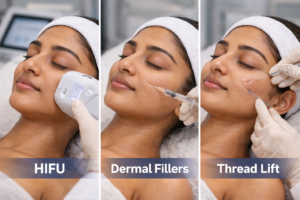

The decision to address skin laxity is one of the most common consultations at House of Aesthetics — and one of the most confusing for patients who have already spent hours researching online. HIFU, Exilis, Thermage, MNRF, RF skin tightening — the landscape of non-surgical tightening treatments is vast, and the marketing around each device is understandably overwhelming.
This guide cuts through the noise. It explains each major technology, how it works, who it is best suited for, and how it compares to the alternatives — so you can have a more informed conversation with your dermatologist and arrive at a decision that makes sense for your face.
Why Does Skin Lose Firmness?
Before comparing treatments, it helps to understand what is actually happening in the skin as it loses its tightness.
Skin firmness depends primarily on two proteins: collagen, which provides structural strength and firmness, and elastin, which gives skin its ability to spring back after movement. Both are produced by cells called fibroblasts in the dermis.
From the mid-20s onwards, collagen production begins to decline at approximately 1% per year. Elastin degrades and is not replaced effectively. The fat pads of the face redistribute and thin. Bone density in the facial skeleton reduces, providing less structural support.
The visible result: jowls, a less defined jawline, hollowing of the cheeks, neck bands, sagging around the eyes and mouth.
The goal of all non-surgical tightening treatments is the same: stimulate the body’s own collagen production mechanism in the dermis — achieving a natural tightening from within rather than cutting or injecting.
How Non-Surgical Tightening Works: The Shared Principle
All major non-surgical tightening technologies (HIFU, Exilis, RF) work through the same fundamental mechanism: controlled thermal injury in the dermis or SMAS layer, which triggers a healing response characterised by new collagen and elastin synthesis.
The differences between technologies lie in:
- The energy type used (ultrasound vs radiofrequency)
- The depth they target (SMAS layer, deep dermis, or superficial dermis)
- The precision of energy delivery
- The tissue types they affect
HIFU — High-Intensity Focused Ultrasound
How It Works
HIFU (High-Intensity Focused Ultrasound) is the deepest-acting of the three technologies. It uses focused ultrasound energy to create precise thermal injury points (coagulation zones) at depths of 1.5mm, 3mm and — most uniquely — 4.5mm, where the SMAS layer sits.
The SMAS (Superficial Musculoaponeurotic System) is the fibromuscular layer that surgeons target in a traditional facelift. HIFU is the only non-surgical technology that can consistently reach and treat this layer — which is why its results most closely approximate a surgical lift in terms of the degree of structural change possible.
Who It Is Best For
- Patients with moderate to significant skin laxity, particularly jowls, jawline definition, and neck tightening
- Patients seeking a “non-surgical facelift” effect — structural lifting rather than surface tightening
- Patients aged typically 35–60, where laxity is present but the degree of change is still achievable non-surgically
- Those who want maximum impact from a single treatment
Results and Timeline
HIFU results are not immediate — they build progressively over 2–3 months as new collagen forms, reaching maximum effect at around 3–6 months post-treatment. Results typically last 12–18 months, at which point a maintenance session is recommended.
Comfort and Downtime
HIFU is the most intense sensation of the three technologies during treatment — some patients find it quite uncomfortable, particularly over bony areas. Pain management (topical anaesthetic, pain relief) can be discussed at consultation. No downtime is required post-treatment — mild redness or swelling may occur for a few hours.
When HIFU is the Right Choice
- Significant jawline sagging / jowl formation
- Visible neck laxity and platysmal banding
- Brow and periorbital lifting
- Patients who want the deepest possible non-surgical structural improvement
Exilis Elite — Combined Radiofrequency and Ultrasound
How It Works
Exilis Elite is a distinctive technology that combines radiofrequency (RF) energy with therapeutic ultrasound in a single device. The dual-energy approach allows it to work at multiple tissue depths simultaneously:
- Ultrasound focuses energy deep into the tissue
- RF tightens and remodels the dermis
Exilis also incorporates controlled cooling to protect the skin surface while the deeper layers are heated — a technology that makes it both comfortable and safe.
Who It Is Best For
- Patients with mild-to-moderate skin laxity who want progressive improvement with maximum comfort
- Body tightening — Exilis is particularly effective for treating laxity on the body (arms, abdomen, inner thighs) as well as the face
- Patients who are sensitive to pain and find HIFU too uncomfortable
- Patients who want a series of gradual improvement sessions rather than a single intense treatment
Results and Timeline
Results with Exilis accumulate over a series of sessions (typically 4 sessions, 1–2 weeks apart for facial concerns, more for body areas). Because the improvement is gradual and cumulative, it is subtler per session but consistent over the treatment course. Results are maintained with periodic top-up sessions every 6–12 months.
Comfort and Downtime
Exilis is often described as a “warm massage” — the controlled heating is comfortable and many patients find it relaxing. Zero downtime.
When Exilis Is the Right Choice
- Mild-to-moderate facial laxity with desire for gradual improvement
- Body skin tightening alongside facial treatments
- Patients wanting frequent, comfortable sessions rather than a single intense procedure
- Post-weight-loss skin laxity on the body
Radiofrequency (RF) Skin Tightening — Standalone and MNRF
Radiofrequency energy heats the dermis, stimulating collagen contraction (immediate tightening) and new collagen synthesis (delayed improvement). Several RF delivery modalities exist:
Monopolar RF (such as Thermage) delivers energy across a large surface area to the deep dermis. Single sessions produce long-lasting collagen remodelling. Thermage is particularly well-regarded for skin texture improvement and mild-to-moderate laxity.
Bipolar RF delivers energy between two electrodes, achieving shallower penetration — more appropriate for fine lines and surface texture than deep laxity.
MNRF (Microneedling RF) — covered in more detail in our MNRF blog — delivers RF energy fractionally through needles at a controlled depth. This is particularly effective for skin texture, acne scars and pore reduction, with a secondary skin tightening effect.
For primary skin tightening goals (particularly lifting), monopolar RF and HIFU are more effective than MNRF, though MNRF has advantages for combined texture and laxity concerns.
Direct Comparison: HIFU vs Exilis vs RF
| Feature | HIFU | Exilis Elite | RF (Monopolar) |
|---|---|---|---|
| Energy type | Focused ultrasound | RF + Ultrasound | Radiofrequency |
| Depth of action | Deep dermis + SMAS (4.5mm) | Dermis to subcutaneous | Mid-dermis |
| Best concern | Significant laxity, lifting | Mild-moderate laxity, body | Mild laxity, skin quality |
| Sessions needed | 1 (with annual maintenance) | 4–6 per course | 1 (Thermage) or series |
| Result timeline | 3–6 months | Progressive, 2–4 months | 3–6 months |
| Comfort level | More intense | Comfortable | Variable |
| Downtime | None | None | None |
| Best age range | 38–60 | 30–55 | 30–60 |
| Face + body? | Primarily face/neck | Face and body | Primarily face |
Which Treatment Is Right for You? A Decision Framework
Choose HIFU if: Your primary concern is jawline laxity, jowls or neck sagging. You want maximum structural lifting from a single session. You are comfortable with a more intense treatment experience.
Choose Exilis if: You have mild-to-moderate facial laxity and want gradual, comfortable improvement. You also want body tightening (arms, abdomen, thighs). You prefer more frequent, relaxing sessions to a single intense one.
Choose MNRF if: Your primary concern is acne scars, skin texture and open pores, with skin tightening as a secondary benefit. You are in your 30s with early laxity combined with textural concerns.
Consider a combination approach if: You have both significant laxity (HIFU to the SMAS) and surface textural concerns (MNRF or Exilis for the dermis). At House of Aesthetics, combination protocols are common for patients with multiple concerns.
The Role of Injectables Alongside Skin Tightening
Skin tightening treatments address structure — but volume loss is a separate issue that tightening cannot correct. A face with significant volume loss and laxity often benefits from:
- HIFU or Exilis for structural tightening
- Dermal fillers (cheek, jawline, temporal) to restore volume
- Profhilo or skin boosters for overall skin quality and hydration
This combination — structure plus volume — produces results that look natural and comprehensive, rather than simply tighter without the fullness that makes skin look youthful.
Book Your Skin Tightening Consultation at House of Aesthetics
The right treatment for your skin laxity depends on its severity, your facial anatomy, your aesthetic goals and your lifestyle. There is no one-size-fits-all answer.
Book a consultation at House of Aesthetics, Greater Kailash. Our dermatologist will assess your degree of laxity, your skin quality and your goals — and recommend the treatment or combination that makes the most clinical sense for you.
We serve patients from across South Delhi — Defence Colony, Hauz Khas, Vasant Vihar, South Extension, Lajpat Nagar, Saket and beyond.
This article has been reviewed and approved by the dermatologist at House of Aesthetics, Greater Kailash, Delhi. It is intended for informational purposes and does not replace a clinical consultation.